
An object in good condition deposited at a recycling center ends up in landfill or incineration. This observation prompts a rethink of the hierarchy of waste management systems: reuse, framed by the AGEC law and structured by extended producer responsibility (EPR) systems, offers a more relevant outlet than the bin for most everyday items.
EPR systems and object sorting: directing donations to the right organization
Not all donations are equal, and not all organizations handle the same categories. A pillow or duvet falls under the Ecomaison furniture system, not the textile system. Confusing them leads to overloading a collection point with items it cannot process.
The confusion between systems remains common among individuals. An incomplete piece of furniture or a non-functional electrical appliance does not belong in a recycling center focused on clothing.
The AGEC law requires retailers to offer free take-back in-store when purchasing or delivering a new product, particularly for furniture, bedding, DIY and gardening items, and electrical equipment. This obligation relieves organizations of overly heavy, incomplete, or difficult-to-resell items.
Before loading a vehicle, one must ask a technical question: is the item suitable for reuse, or does it fall under material recycling? If the answer leans towards recycling, the retailer’s take-back or the Ecomaison collection point is the appropriate channel. When the item can still be used, it makes sense to donate instead of throwing away with Concept Habitat, ensuring that the receiving organization accepts this category.
Ecomaison partner organizations: a structured collection network
The French associative network no longer relies on spontaneous volunteering. Ecomaison works with 630 partner organizations that combine collection, sorting, reuse, and support for local employment in the social and solidarity economy. This network covers the majority of the territory and allows for organized pick-up or drop-off.
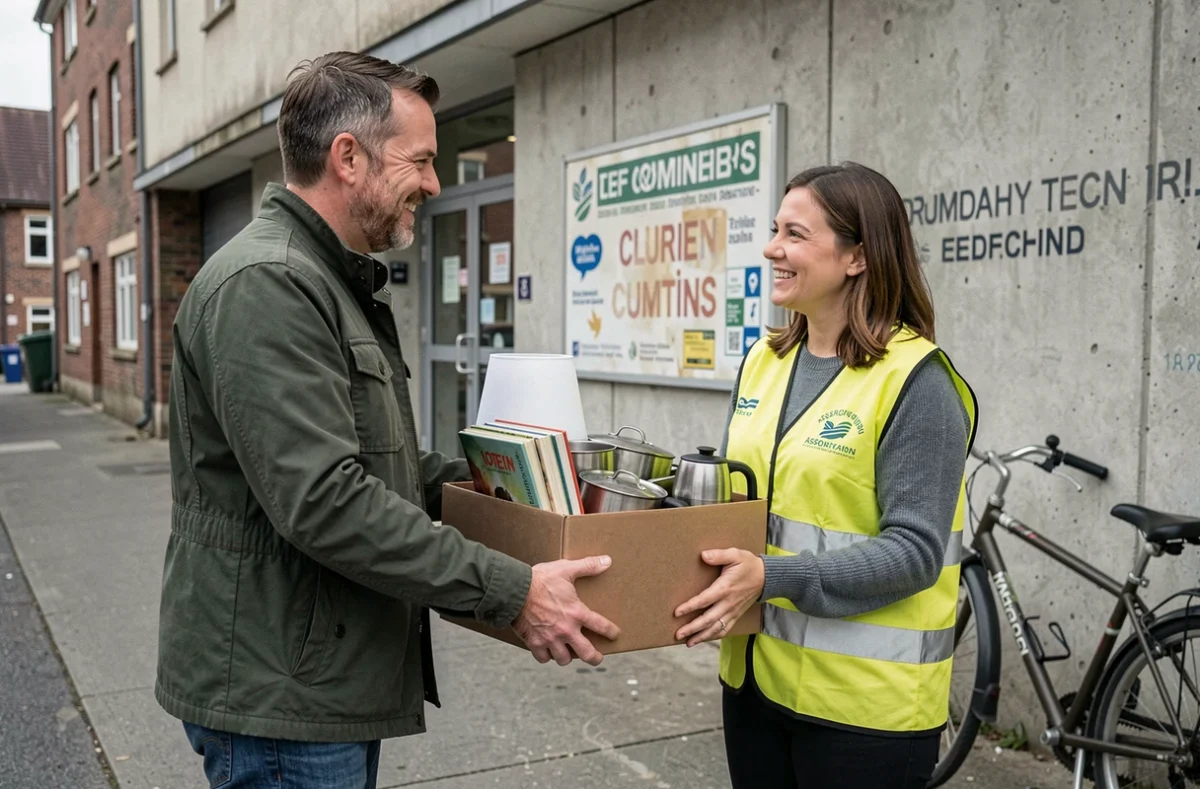
Recycling centers are the most visible link in this system. They accept a wide range of items (furniture, books, clothing, dishes, small appliances) as long as their condition allows for circulation without heavy repairs. Specialized structures, like the Recyclerie Sportive in Grenoble, target specific categories: sports equipment, outdoor gear.
Each structure applies its own acceptance criteria. A rejected drop-off generates additional logistical costs for the organization and an extra waste. Systematically checking acceptance conditions before any trip, by directly contacting the organization or consulting the Ecomaison directory, remains necessary.
Most sought-after object categories by organizations
- Clothing and shoes in good condition, clean and dry, placed in closed bags to avoid degradation during transport.
- Complete and functional furniture (no three-legged chairs or wardrobes without doors) that organizations can resell directly.
- Books, games, and complete toys, without missing pieces, that supply solidarity shops and community libraries.
- Small appliances in working order, tested before drop-off, preferably accompanied by their power cord.
Geev app and peer-to-peer donation platforms: complements or alternatives
Apps like Geev have opened a direct donation channel between individuals, bypassing organizations. This channel works well for small, easily transportable items whose nature does not justify organizational logistics.
Peer-to-peer donations do not replace the structured associative network. An organization sorts, checks quality, and directs items that cannot be reused towards recycling. On a peer-to-peer platform, a defective item given in good faith often ends up in the trash at the recipient’s place.
The advantage of Geev lies in speed: posting an ad, geolocation, pick-up in a few hours. For a move or large-scale sorting, associative collection with pick-up remains more suitable. The two channels are complementary, not interchangeable.
AGEC law and retailer take-back: what organizations cannot absorb

The AGEC law has extended the obligations for free take-back by retailers to many categories. This provision is particularly useful for bulky or end-of-life items that organizations justifiably refuse.
- Mattresses and box springs, even deformed or stained, taken back during the delivery of an equivalent new product.
- Large appliances (refrigerators, washing machines) taken back by the retailer, even if broken.
- DIY and gardening items, often too specialized for general recycling centers.
Retailer take-back absorbs what donations cannot cover. Knowing this channel prevents depositing items in an organization that will have to send them to a recycling center at its own expense.
Sorting before donation: a technical step not to be overlooked
A three-stream sorting process is essential before any action. First stream: items in good condition, directed to an organization or donation platform. Second stream: end-of-life items but falling under an EPR system, directed to retailer take-back or an approved collection point. Third stream: residual waste, for the recycling center.
This prior sorting respects the regulatory hierarchy of treatment methods (reuse, then recycling, then energy recovery, then disposal). It also ensures that each structure receives items it can actually process, without wasting its human resources on additional sorting.
Donation remains the most relevant gesture for a functional item. The often underestimated condition is to choose the right system according to the state and category of the item. A clean pair of shoes in a textile container, a complete piece of furniture at a recycling center, a worn mattress taken back by the retailer: each item has its own channel. Sorting upstream of the donation determines the actual efficiency of reuse.