When you order a tonne of flour to supply a bakery, the delivery note shows 1,000 kg. The relationship is simple, exact, and leaves no room for approximation: 1 metric tonne is exactly 1,000 kilograms.
The calculation itself is never the problem. The confusion comes from what you do with those kilograms next, especially when a recipe mixes mass and volume, or when the word “ton” in an English-language specification doesn’t mean the same thing as a metric tonne.
Mass and volume in the kitchen: the confusion that throws off proportions
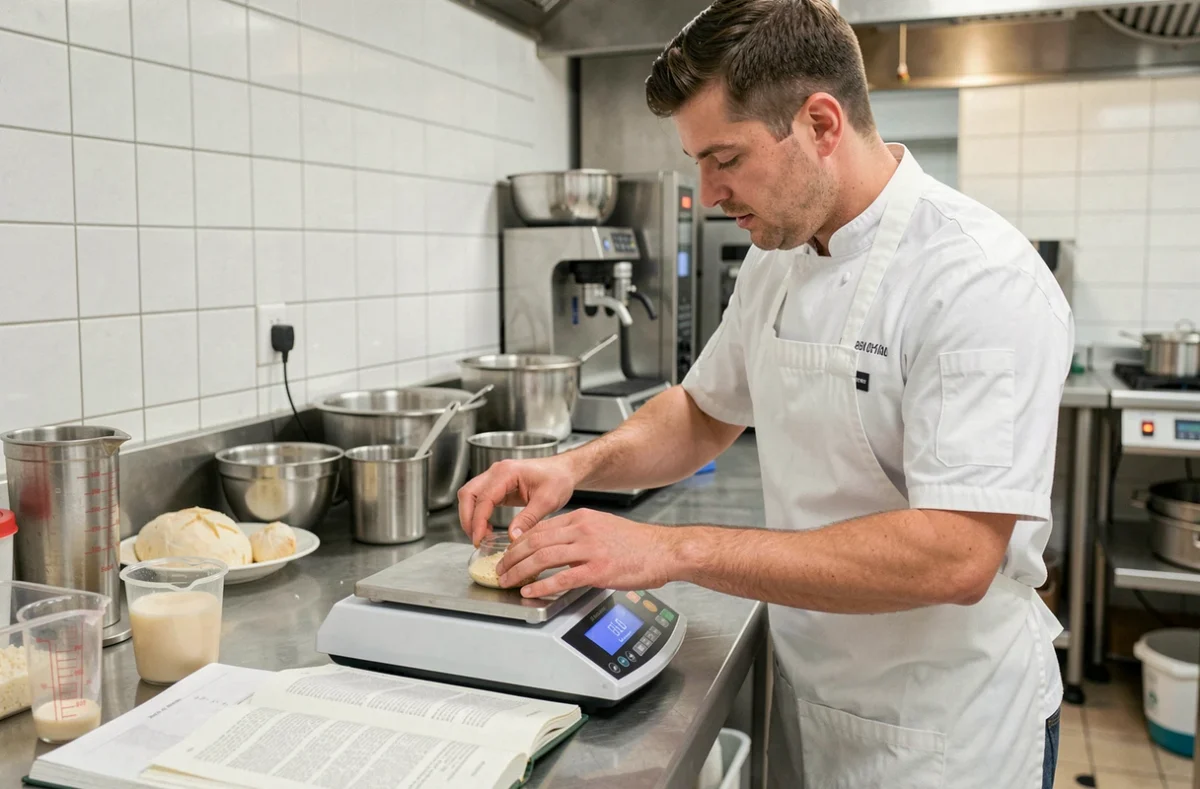
A restaurateur adapting an industrial recipe thinks in kilograms. Someone at home reading the same recipe thinks in litres, cups, and tablespoons. Converting tonnes to kilograms is straightforward: divide or multiply by 1,000. The real risk arises when you convert those kilograms into volume.
The reason comes down to one word: density. One kilogram of water occupies one litre (at room temperature, as a common approximation). One kilogram of wheat flour takes up considerably more space because flour is less dense than water. Without knowing an ingredient’s density, converting kilos to litres will give you the wrong result.
When working with the conversion of tonnes to kilograms for bulk purchases of sugar, oil, or grains, the mass remains reliable. Volume, however, varies depending on the product’s particle size, how tightly it is packed, and its temperature. Whenever quantities exceed a few kilos, it’s always better to weigh ingredients than measure them by volume.
Metric tonne, short ton, long ton: three units for the same word
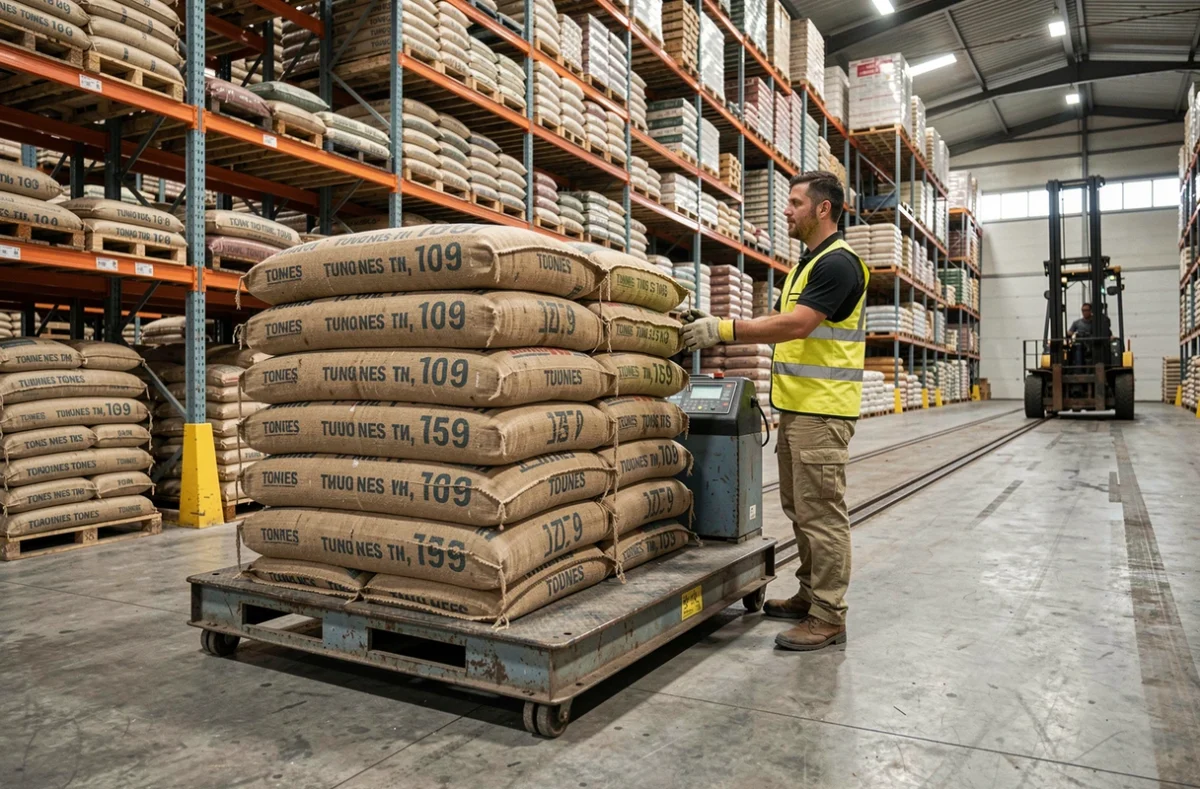
The English word “ton” refers to three different units. This is a common pitfall when translating an American recipe or placing an order with an English-speaking supplier.
- The metric tonne (symbol: t) is exactly 1,000 kg. It is recognized alongside the International System of Units by the BIPM, although it is not one of the SI base units.
- The short ton, used in the United States, is approximately 907 kg. A US professional recipe that calls for “1 ton” of a raw ingredient means this amount, not 1,000 kg.
- The long ton, still used in some industrial contexts in the United Kingdom, is approximately 1,016 kg.
The difference between a short ton and a metric tonne is more than 90 kg. For an order of food ingredients, this can amount to several hundred euros and completely throw off the quantities in a large-scale production run.
What to check before converting
Before converting, check the original unit. If the source document is in English, look for the term “metric ton” or the symbol “t”. If there’s no clarification, ask the supplier to confirm. Never assume that an English “ton” is a metric tonne.
Tonnes-to-kilograms conversion table for large quantities
For bulk orders or production planning, a table helps prevent data-entry errors. The conversion is still a simple multiplication by 1,000, but seeing the quantities laid out makes it easier to check that a purchase order is consistent.
| Tonnes (t) | Kilograms (kg) |
|---|---|
| 0.1 | 100 |
| 0.25 | 250 |
| 0.5 | 500 |
| 1 | 1,000 |
| 2 | 2,000 |
| 5 | 5,000 |
| 10 | 10,000 |
This table covers the most common quantities in institutional catering, artisan bakeries, and agricultural supply. For unusual fractions, the rule remains the same: multiply the number of tonnes by 1,000.

Check that a bulk order adds up
If you receive a quote for 0.75 t of butter, you should expect 750 kg on the delivery dock. If the scale shows a significant discrepancy, it’s often because the supplier billed in short tons or because the packaging weight is included (gross weight rather than net weight).
Convert kilograms into recipe portions: a straightforward method
In a professional kitchen, you rarely start with a tonne for a single preparation. You receive the raw ingredients by the tonne, then divide them into kilograms and grams for each recipe. The conversion down to smaller units follows a straightforward decimal system:
- 1 t = 1,000 kg
- 1 kg = 1,000 g
- So 1 t = 1,000,000 g
To scale a recipe from 10 portions to 500, multiply each ingredient by 50. If the original recipe specifies 200 g of sugar, you’ll need 10 kg, or 0.01 t. Using kilograms for intermediate quantities helps avoid long decimal figures.
When density makes all the difference
A litre of olive oil doesn’t weigh one kilogram. Its density is lower than water’s, which means a litre of oil weighs less than a litre of water. Conversely, a litre of honey weighs considerably more than a kilogram because of its high density. Every liquid or semi-liquid ingredient needs its own mass-to-volume conversion table.
In France, Decree No. 61-501 of May 3, 1961, is the regulatory reference for legal units of measurement. In commercial or regulated contexts, relying on this text rather than a general-purpose online converter helps ensure that labels and transaction documents comply with the rules.
Converting tonnes to kilograms holds no arithmetic surprises. Errors happen earlier, when you don’t check whether a foreign supplier’s “ton” really means 1,000 kg, or later, when you convert kilos to litres without accounting for the product’s density. Keeping this distinction in mind is enough to ensure accuracy, whether you’re ordering several tonnes or scaling up a recipe.