Perhaps you are already aware of this event given the communication that has been made about it since the beginning of the year.
Alongside being an artist, Leonardo da Vinci was a great inventor and a visionary of his time. So why not pay tribute to him, since we share the same taste for discovery?
Son of Ser Piero, a notary of the Florentine lordship, and a peasant woman, Leonardo di ser Piero da Vinci was born in Vinci, near Florence in 1452 and died at the Manor of Cloux, now the Château de Clos-Lucé, in Amboise, in 1519.
His life, his beginnings in Florence
In 1469, Leonardo da Vinci entered the workshop of Verrocchio, who taught him painting and sculpture, and especially the technique of perspective (Annunciation, 1473, Portrait of Ginevra Benci, 1478-1480).
He also introduced the art of “sfumato,” a kind of veil that dilutes plastic masses into a reality, making the transition between colors, shadows, and lights imperceptible (Adoration of the Magi, circa 1481, unfinished).
In Milan
To participate in the dissemination of Florentine know-how at the request of Lorenzo de’ Medici, he left for Milan in 1482, where he was both a military engineer, architect, painter, sculptor, and a major author of festivities at the Sforza court.
He worked for 16 years on the equestrian statue of Francesco Sforza, a gigantic work that would never be cast. He also participated in discussions about the construction of the cathedrals of Milan and Pavia and painted two masterpieces: the Virgin of the Rocks, circa 1482-1483, and The Last Supper of 1497.
The Mona Lisa
In 1499, the Duchy of Milan fell into the hands of the French, and Leonardo da Vinci went to Mantua, where he painted the portrait of Isabella d’Este. In Rome, he worked as a military engineer for Cesare Borgia before returning to Florence.
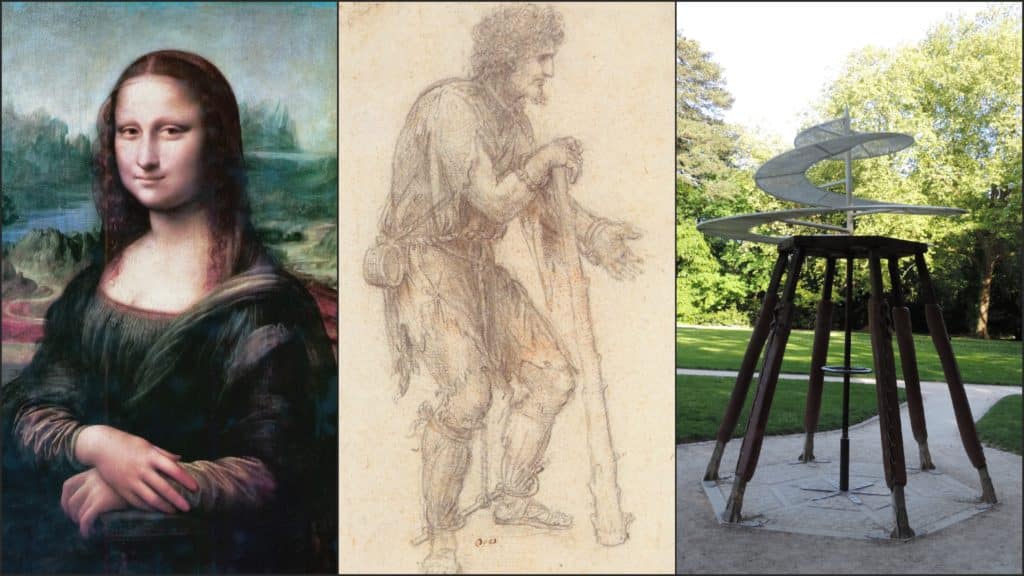
There he painted the Mona Lisa around 1503-1507 and the Virgin, the Child Jesus, and Saint Anne around 1508-1510. The Battle of Anghiari, a fresco intended for the Palazzo Vecchio (circa 1503-1505), is known only through drawings, such as Leda (between 1504 and 1508).
Last Travels
In 1508, he was again in Milan, where Bernardino Luini and Andrea Solario would be his disciples. He then composed an equestrian monument for the tomb of the Condottiere Trivulzio (1511-1512).
He then spent two years in Rome, where he was called by Giuliano de’ Medici; from this moment dates the Saint John the Baptist of the Louvre (circa 1514-1515). Finally, in 1516, he accepted the offer of Francis I, who invited him to his court and settled him at the Manor of Cloux (now Château de Clos-Lucé), near the Château d’Amboise. He proposed plans for an ideal castle for the King of France — who confided that he did not believe “that one man possessed so much knowledge.” It was at Clos-Lucé that he died on April 23, 1519.
Scholar and Engineer: Passion for Knowledge
Leonardo da Vinci was interested in all branches of science, as evidenced by his writings and drawing books (collections of Clos-Lucé and Windsor Castle, England). As a scientist, he was interested in the visible universe, its structures, and its movements.
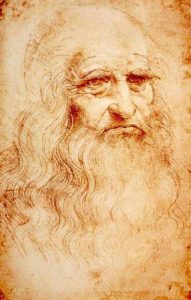
A serene and solitary stoic man, this master of innovation rejects authority and bases his judgment on experience.
He is not a scientist who renews science through his discoveries or hypotheses, like Copernicus or Newton, for example. While celebrating “the supreme certainty of mathematics,” he is above all a “visual” thinker, for whom the eye, “the window of the soul,” is the main way through which our intellect can fully appreciate the infinite work of nature. His universal curiosity denies the distinctions between pure science and applied sciences, between fine arts and mechanical arts.
Three Areas of Choice
His research covers various fields such as astronomy and geology, geometry and mechanics, optics and acoustics, botany and metallurgy. But three dominant notebooks emerge from his notebooks due to the abundance or uniqueness of the notations.
- First anatomy: meticulous descriptions, multiple dissections, illustrated by magnificent drawings, some of which are dedicated to comparative anatomy. He is a sort of isolated precursor to Vesalius, the founder of modern anatomy. (Leonardo da Vinci, study of the shoulder muscles).
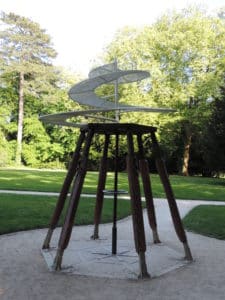
- Then mechanics, applied to the work of the engineer — ballistic inventions, reservoirs, pumps and dredges, bridges and canals — and to projects for flying machinery, whose sketches are based on the study of birds’ flight. He also imagines an ancestor of the diving suit or the spring tricycle.
- Finally, the life of the globe, through fluid mechanics and geology: studies of vortices, panoramic sketches showing the formation of alpine valleys, analyses of fossils, shell shapes, etc.
Aesthetic Heritage
In continuity with all the aspirations of the Florentine quattrocento, Leonardo da Vinci completed, in painting, the conquest of chiaroscuro, whose influence would be so decisive. The author of only eighteen finished paintings, he leaves a body of work of immense value.
It is complemented by theoretical writings, published in French in 1942 under the title of Notebooks of Leonardo da Vinci; they include the Treatise on Painting, which the artist conceived around 1490 and published in 1651.
Some Quotes from Leonardo da Vinci
“In times of peace, I can correspond, I believe, with anyone in architecture, build private and public monuments, and lead water from one place to another.” — In a letter to the Duke of Milan, Ludovico Sforza il Moro.
“Painter, do not let your colors diminish in perspective more than the figures that bear those colors.” — Treatise on Painting
“The divine character of painting makes the spirit of the painter transform into the image of the spirit of God.” — Treatise on Painting
Discover, deepen, or rediscover Leonardo da Vinci:
In France:
- The exhibition “The Death of Leonardo da Vinci: The Construction of a Myth,” organized at the Château d’Amboise in partnership with the Bibliothèque nationale de France. From May 2 to September 2. Workshops, exhibitions, concerts, escape games… Complete program of events on the Leonardo da Vinci year website.
- Events at Clos Lucé: www.vinci-closluce.com/fr/events
- From October 24, 2019, to February 20, 2020, an exceptional retrospective on “Leonardo da Vinci” at the Louvre, Paris. Mandatory reservations will open from June 18. Information to come on the Louvre Museum website.
In Italy:
- Numerous exhibitions are taking place in Vinci and Florence, including “Leonardo and Florence,” where excerpts from the Codex Atlanticus will be displayed until June 24. Information on the Florence city museums website.
- Exhibition “Leonardo da Vinci. Parade”: Until October 13, the city of Milan hosts a selection of machines built according to the inventor’s plans. Information on the Leonardo da Vinci Museum of Science and Technology website.
Tag: the life of Leonardo da Vinci